
Check the risks before choosing an online Keno site
The guide separates Australian law from offshore access and explains why demos, strategies and bonuses do not remove practical risks.
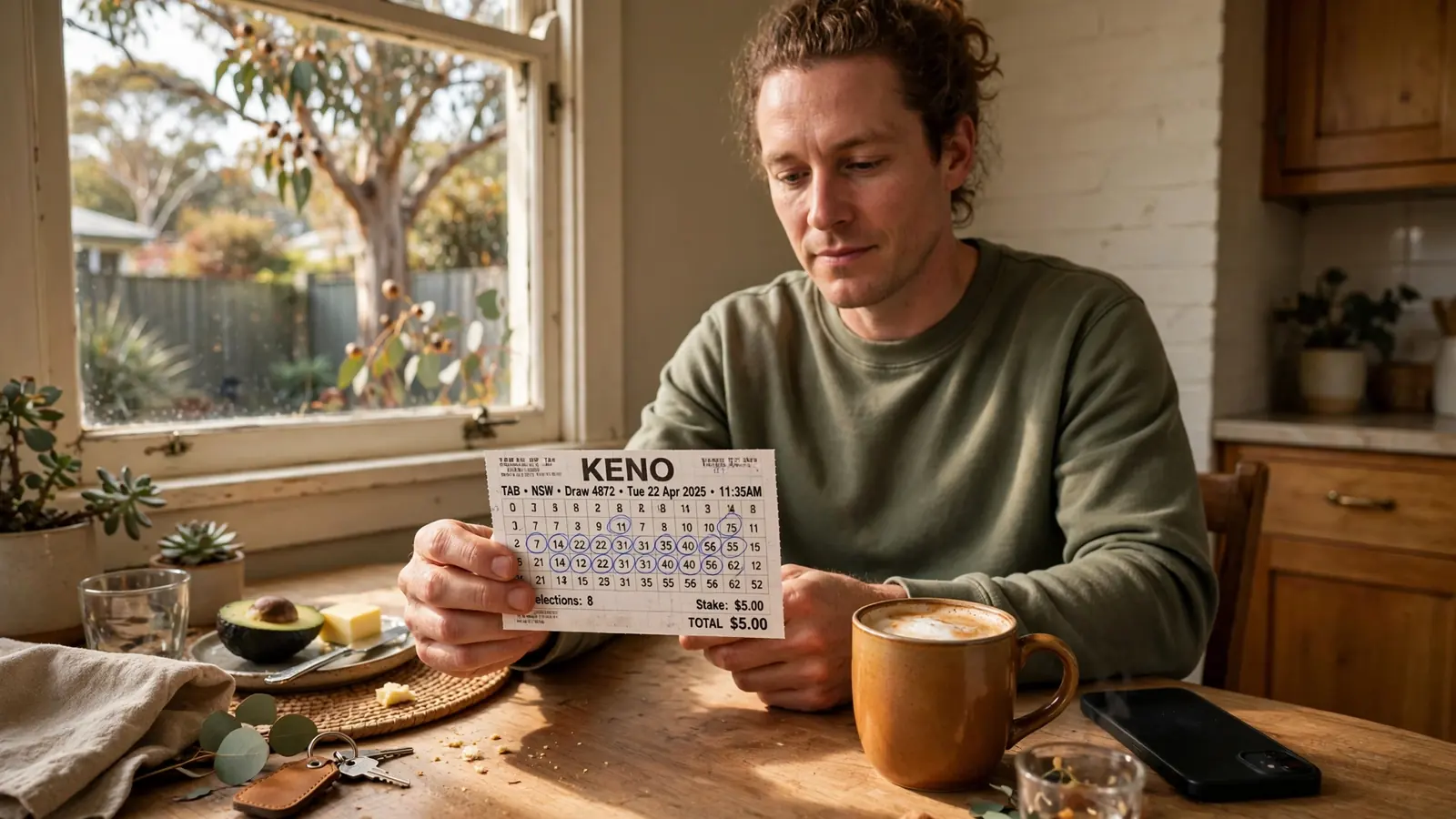
The Australian Keno Question Starts With the Law
When I look at claims about the best Keno casino for Australians, I start with the part the sales copy tends to push into the background: there is no Australian-licensed online casino. That changes what a “best” list can honestly mean. It cannot be a shortlist of locally licensed casinos, because there are none.
The Interactive Gambling Act 2001 prohibits operators from providing real-money online casino games to people in Australia without a domestic licence. That category covers casino-style games, including Keno when offered as an online casino game. No domestic online casino licences have been issued. So a page presenting online Keno casinos as though they were approved local businesses would give you the wrong impression before you even reached its recommendations.
I have learned to pause when a page uses words such as “trusted” or “Australian-friendly” as if either one settled the legal question. They do not. A site may use Australian currency, accept Australian customers, or put Keno in its game menu; none of those details makes it an Australian-licensed casino. Familiar branding is not the same thing as local authorisation. Not even close.
Top operators
Choosing an online casino for keno involves more than the game itself: payment options and licensing details can help you assess what is disclosed. Use the details below as a quick reference when considering your options.
-
Ricky Casino
- Payout speed
- crypto under 1 hour, PayID 1-3 business days
- Min. deposit
- A$20 (A$30 to qualify for the bonus)
You can deposit from A$20, though A$30 is required to qualify for the bonus. Crypto payouts are listed as taking under an hour, while PayID payouts take 1–3 business days.
-
SkyCrown
- License
- Tobique Gaming Commission
- Payout speed
- crypto ~10-15 minutes, fiat 1-5 days
- Min. deposit
- A$30
You can consider SkyCrown if its disclosed licensing and payment details matter to your choice: it lists a Tobique Gaming Commission licence. Crypto payouts are estimated at around 10–15 minutes, fiat payouts at 1–5 days, and the minimum deposit is A$30.
-
LevelUp Casino
- License
- Curacao eGaming OGL/2023/174/0082 (Dama N.V.)
- Min. deposit
- A$15
LevelUp Casino lists a Curacao eGaming licence, OGL/2023/174/0082, held by Dama N.V. The minimum deposit is A$15.
-
JustCasino
- License
- Curacao Gaming Control Board
JustCasino lists a Curacao Gaming Control Board licence. That is the licensing detail available here for you to consider.
-
House of Pokies
- License
- international iGaming licence – jurisdiction not named in the source
- Payout speed
- PayID 1-24 hours
- Min. deposit
- A$30 (PayID from A$10)
House of Pokies lists an international iGaming licence, though the jurisdiction is not named in the source. PayID payouts are listed at 1–24 hours; the minimum deposit is A$30, or A$10 when using PayID.
-
WinSpirit Casino
- License
- Curacao eGaming OGL/2024/923/0383 (Antillephone N.V.)
- Min. deposit
- A$30
WinSpirit Casino lists a Curacao eGaming licence, OGL/2024/923/0383, held by Antillephone N.V. Its minimum deposit is A$30.
-
Bizzo Casino
- License
- Curacao Gaming Control Board (TechSolutions Group N.V.)
Bizzo Casino lists a Curacao Gaming Control Board licence associated with TechSolutions Group N.V. This licensing detail is the information available here for you to assess.
-
Kingmaker
- Payout speed
- crypto ~90 minutes, fiat 1-5 days
- Min. deposit
- A$30
Kingmaker lists crypto payouts at around 90 minutes and fiat payouts at 1–5 days. The minimum deposit is A$30.
-
Wild Tokyo
- License
- Curacao
- Payout speed
- crypto 30-60 minutes, fiat 1-5 days
- Min. deposit
- A$10
Wild Tokyo lists a Curacao licence and a minimum deposit of A$10. Crypto payouts are listed at 30–60 minutes, while fiat payouts are listed at 1–5 days.
-
LuckyVibe
- License
- Curacao Gaming Control Board OGL/2023/176/0095 (Hollycorn N.V.)
LuckyVibe lists a Curacao Gaming Control Board licence, OGL/2023/176/0095, held by Hollycorn N.V. This is the licensing detail available here for you to consider.
That distinction matters more than the ranking language. A “best online Keno casino” label sounds like a comparison within one clear market, where the options share a local framework. Here, that premise does not hold. A list can describe what a publisher prefers, but it cannot turn offshore operators into locally licensed casinos by placing them in a table or attaching a confident score.
I would also be wary of treating a list as proof that someone has checked every claim on it. A polished review can still leave the basic question unanswered: what legal standing does the operator have in Australia? If a page blurs that point, its recommendation is not doing the job a reader needs it to do. A neat badge is still just a badge.
There is a separate point that is easy to misread. The prohibition is directed at companies that provide the service, rather than at individual Australians who choose to play. That does not amount to a local endorsement of a casino, and it does not provide the player with the protections of an Australian-licensed operator. Those are different questions, and folding them together makes the situation sound safer and simpler than it is.
The practical limit is blunt: if an offshore casino refuses to pay winnings, an Australian player has no legal recourse in Australia against that casino. I would not dress that up with softer language. A review can describe its own assessment, but it cannot give you an Australian licence to rely on or create a local route to recover money when a dispute goes badly. That is a serious difference from choosing among businesses operating under a domestic casino licence.

So when someone asks me for the best Keno option online in Australia, I do not think a responsible answer is to present an offshore list as a verified set of Australian casinos. The law leaves no locally licensed online casino pool to rank. And where the operator is offshore, a confident “best” label does not remove the limits on your recourse if the outcome is disputed.
This is not hair-splitting. “Available to Australians” and “licensed in Australia” are not interchangeable descriptions. The first can refer to an operator willing to take customers; the second would suggest local authorisation that does not exist for online casinos. If a page treats them as synonyms, I would stop trusting its wording. It is a basic distinction, not a footnote.
The same caution applies to searches for online casino Keno or Keno games offered through a casino-style site. Changing the order of the words does not change the legal category of the service. A game does not become a locally authorised product because it is called Keno rather than a casino game, or because the page is aimed at Australian readers.
My standard is simple: say plainly that no Australian-licensed online casino exists, and do not imply that an offshore recommendation has local approval behind it. That leaves less room for a flashy “best” claim, but it gives you a more accurate starting point. The law comes first.
Real Money, Offshore Operators, and the Risk You Take
The awkward part of looking for real-money Keno online in Australia is that the law draws a line between the person playing and the business taking the bet. Under the Interactive Gambling Act 2001, an operator cannot lawfully provide real-money online casino games to people in Australia without a domestic licence. None has been issued. The rule is aimed at the operator, not at an individual who chooses to play.
That distinction matters, but it is easy to misread. Australians are not made liable simply for playing on an offshore site that accepts them; the law does not treat the player as the party committing the offence. That does not make the service locally licensed, or turn an offshore account into one backed by Australian protections. The operator’s legal position and your practical position are two different things.
I used to see “available to Australians” and read it as a kind of approval. It isn’t. A site may allow a sign-up or take a deposit without having permission to provide an online casino service here. The fact that you can reach a page, create an account, or find a Keno game there tells you what the operator permits on its own platform. It does not settle what happens if there is a dispute.

That is the real-money risk I would put ahead of any game description. If an offshore casino refuses to release winnings, an Australian player has no legal remedy in Australia to compel payment. You could contact the operator and argue your case, but that is not the same as being able to take the matter to an Australian body with authority over that casino. A foreign licence, if an operator claims to hold one, should not be mistaken for an Australian licence or an Australian route to recover money.
“Secure” can mean the site uses technical safeguards; it does not mean your balance is guaranteed. “Trusted” is a label, not a promise that you can enforce locally. I learned to stop treating reassuring words on a casino page as a substitute for knowing who is accountable when something goes wrong. With offshore play, that gap can become very real when the amount on screen is no longer just a number.
This is why I would not describe offshore real-money Keno as an ordinary Australian casino purchase. You may be legally free as a player to use a site that accepts you, but the service itself is not being supplied under a domestic online-casino licence. And if the operator disputes a withdrawal or simply does not pay, the local legal safety net you might expect from an Australian business is not there. Those are separate points, and both matter.
The same caution applies whether a page calls its game Keno, a casino game, or something else. The label does not change the key question: who is responsible for the service, and where could you pursue a remedy if the operator does not honour its side? If the answer points offshore, you are relying on that operator’s own process rather than an Australian casino regulator or court able to make it pay.
I’m not saying every offshore operator will refuse a payout. I’m saying that a promise to pay and a remedy you can use are not the same thing. If you are weighing a real-money game, make that distinction before depositing—not after a dispute, when you have fewer options. That is the part I wish I had understood sooner. A playable site is not a protected one.
Casino Sites, Australian Oversight, and What It Can’t Guarantee
When I see a site described as an Australian Keno casino, I treat “Australian” as a claim to examine, not proof of local approval. A page can use Australian language, display prices in Australian dollars or advertise Keno alongside pokies. None of those details makes it an Australian-licensed online casino.
The regulator to know is the Australian Communications and Media Authority (ACMA). It enforces the Interactive Gambling Act 2001, including the rules against providing prohibited online casino-style gambling services to people in Australia. ACMA also blocks access to illegal offshore gambling sites. Internet service providers are required to follow its blocklist.
That is meaningful oversight, but it has a specific job: restricting access to sites identified as illegal offshore gambling services. It does not turn those operators into local licensees, certify their Keno games or promise that a site will behave fairly. A blocked site is not made legitimate by reappearing under another name, and an unblocked one should not be read as having passed an Australian licensing check.

A search result calling something one of the “best” Keno sites is no substitute for that distinction. Neither is a polished page offering Keno pokies, online Keno or a live presentation of a draw. Those labels describe what the operator says it offers; they do not establish who oversees it in Australia. I have learned to distrust the tidy badges and confident wording. They can look official without answering the important question.
There is no Australian-licensed online casino. So if a site presents itself as a local casino for real-money play, be careful about what “local” means. ACMA’s role and the blocklist are not endorsements, and they do not create an Australian licence for a foreign operator. Nor does a site’s continued availability prove approval: blocking is an enforcement measure, not a public seal of quality for every site that remains reachable.
This matters for all the variations that turn up under Keno: a casino with Keno games, a site promoting Keno slots, or a service that calls its offering live Keno. The game label does not change the regulatory position. A payment logo or a claim about a particular payment method does not change it either. The key point is not whether a page has the right-looking design; it is that Australian oversight does not license offshore casino services.
I would also avoid treating ACMA’s blocklist as a complete directory of every questionable site. Its existence tells you that the regulator can restrict access to identified illegal offshore services and that providers must comply. It does not mean a reader can use the list to certify every operator not appearing on it. A site’s absence from a blocklist is not evidence that it has an Australian licence.
There is a practical difference between enforcement and assurance. Enforcement can limit access; it cannot make an offshore operator an Australian-regulated business or guarantee what happens on its platform. That is why a list of “top” Keno casinos, however convincing the wording, cannot be presented as a verified list of Australian-licensed options. There are no such online casino licences in Australia.
So when a site claims to be an Australian Keno casino, read the claim narrowly. ACMA oversees the relevant law and blocks illegal offshore gambling sites, with internet providers required to carry out those blocks. That is not the same as approving every site that offers Keno, and it is not a promise about what any operator will do. The distinction is easy to miss. It matters.
Keno Games: Random Draws, Not a Reliable Pattern
A Keno title can look like a simple run of numbers, but a string of past results is not a map of what comes next. The useful point to keep in mind is that each pokie spin is an independent event, determined by a Random Number Generator (RNG). A previous result does not make a particular result “due”, and a run that feels unusually lucky or unlucky does not tell you what the next spin will do.
I used to read meaning into streaks. A result would repeat, or a number would seem to have gone missing, and I’d start treating the history as a clue. It wasn’t. The game’s display can show what has happened; it does not turn those outcomes into a reliable forecast. Past results are a record, not a signal.

That distinction matters when a game is presented as Keno inside an online casino. The label alone doesn’t tell you enough to judge its configuration, and the word “random” is not a promise that a session will feel evenly spread. Independent outcomes can cluster or leave gaps. Our brains are good at spotting patterns, even when a sequence does not give us a dependable way to predict the next result.
There is another detail that can be easy to miss: the same pokie may not have the same return-to-player setting everywhere. A specialist review reports that some providers give casinos a choice of RTP settings for a particular game. So seeing a familiar title in two places does not, by itself, establish that the games are configured identically.
RTP is a theoretical return measure over extended play, not a forecast of what you will get in one session. It does not say that a player will receive a particular share of their stake back, nor does it make losses temporary. Even when two versions display the same title and artwork, check the game information for the RTP setting rather than assuming the figure is identical. If the setting is not clearly shown, you cannot compare it confidently from the title alone.
That is a configuration question, separate from whether a game uses an RNG. Random outcomes and RTP settings describe different things: the RNG determines each individual result, while RTP describes the game’s theoretical return over time. Neither makes a particular sequence predictable. A higher displayed return would not tell you when a win will happen, or guarantee a better outcome in your own play.
Do
- Check the game information panel for the stated RTP
- Treat each result as an independent event
- Use the information panel to verify game settings
Don't
- Treat past results as a forecast for future wins
- Assume a familiar title has the same RTP everywhere
- Rely on "hot numbers" theories to predict outcomes
When I check a Keno-style game now, I try to separate what I can verify from what the presentation merely suggests. I look for the game’s information panel, including any stated RTP, and avoid treating recent results as evidence about future ones. If the details are absent or unclear, I don’t fill in the blanks with a guess. That’s less exciting than a “hot numbers” theory. It’s also more honest.
The same caution applies when the game is opened through a casino app rather than a browser. A different screen or shortcut does not make outcomes more predictable, and the app label does not tell you which RTP setting is in use. Check the information for the game itself; don’t assume that a mobile version shares every configuration detail with another version.
There is no pattern-reading trick hidden in a run of results. I learned that the expensive way: randomness can look meaningful while offering no dependable forecast. Check what the game actually discloses, keep the distinction between RNG and RTP clear, and don’t let a familiar title persuade you that you know what comes next.
Keno Machines and the Venue Rules That Don’t Apply Online
“Keno machine” can mean different things depending on where you are. In a venue, people may use it to describe a physical gaming machine; online, the same wording can get mixed up with digital Keno games or pokies. The labels blur together, but rules written for a venue do not automatically apply to a game on a screen.
I’ve made that mistake myself: I saw a rule about machines and assumed it covered the online version too. It didn’t. The important distinction is the setting. Venue requirements concern the people and equipment on the premises, not every product that happens to use the word Keno.

A report by regionriverina.com.au describes a requirement for venues with more than 20 gaming machines to have a dedicated responsible gambling officer (RGO) on duty while those machines are operating, from 1 July. That is a venue staffing rule. It is not evidence that an online Keno site has an RGO available to you, or that the venue rule supervises play through a website.
The same report outlines a gambling incident register for venues. It is intended to record events, including situations where a patron’s behaviour suggests they may be at risk of gambling harm or already affected by it. That is a record kept in a physical venue, where staff can observe what is happening on site. A webpage does not become subject to that venue register simply because someone calls its game a machine.
Different setting. Different rule.
So if you are trying to work out whether you can play Keno on a physical machine, check the rules that apply to the venue and the state or territory it is in. If you mean a game on a phone or computer, don’t use a venue requirement as proof that the online product has the same staff, monitoring or protections. The words may sound similar; the arrangements are not interchangeable.
I’d also be wary of treating “machine strategy” as a way to make venue or online play safer. A label cannot tell you who is responsible for the product or what safeguards are actually in place. Keep the question narrow: are you looking at a physical venue, or an online game? That one distinction clears up a lot of crossed wires.
Venue-specific rules
Requirements such as having a dedicated responsible gambling officer (RGO) and maintaining a gambling incident register apply to physical venues with more than 20 gaming machines, not to online Keno sites.
And if you are standing in a venue, the RGO and incident-register requirements described above belong to that setting. They are not a reason to assume an online game is monitored in the same way. Same word, different place.
Free Keno Play: Don’t Mistake a Demo for a Cash-Out
Free Keno can sound like a harmless way to try a game before putting money at risk. The important distinction is what “free” means on the screen: a practice version uses play credits, while real-money play involves deposits and the possibility of losing money. A demo balance is not a cash balance, and a win shown in practice mode should not be treated as money you can withdraw.
I’ve made the mistake of seeing a big number appear in a game and letting the feeling outrun the facts. Before you spend time on a free Keno game, check whether it is explicitly described as practice or demo play. Look for what happens to the balance, whether the game asks for a deposit, and whether the terms say that any practice winnings have no cash value. If that wording is hard to find, don’t assume the displayed credits can be cashed out.
A free version can help you understand the interface: where to select numbers, how a round is started, and where the result appears. It can also let you decide whether the pace suits you without staking money. But it cannot show that you will win in real-money play. A practice result is just that: a result in practice mode. It does not create a claim to a payout.

Availability is not something to take for granted, either. A site may describe a game as free, offer a demo, or require registration before showing anything; those arrangements can differ. I would not rely on a label alone. Read the page and any terms attached to the play mode, and leave if the distinction between practice credits and withdrawable funds is unclear.
If you move from free play to real-money play, you have crossed into a different decision. You are no longer just learning the controls; you are risking money. Keep that line clear, and don’t deposit simply because a demo session went well. Free play is not a preview of a cash-out. It is practice, and its limits matter.
One more thing: “free” can describe the game mode, not the whole experience. A prompt to register or deposit is not proof that you need to follow it to keep practising, nor is a displayed win a promise of payment. Take the wording literally, check what the balance represents, and stop when you cannot tell. No guesswork.
Keno Strategy, RTP, and the Limits of Trying to Beat Randomness
I used to think a run of results had to mean something. A few wins in a row felt like a signal; a losing stretch felt as if a win was “due”. Neither feeling gives you a useful read on the next result. Each spin is an independent event, generated by a Random Number Generator (RNG). Previous outcomes do not tell you what comes next.
- Set a deposit limit you can afford to lose
- Establish a loss limit to stop play
- Define a session time limit
- Determine a clear stopping point before starting
That matters whether you call it Keno, a pokie, or an online slot. A strategy can change how you manage your play, but it cannot turn random results into a predictable sequence. Tracking numbers, changing your stake after a loss, or waiting for a favourite pattern may feel active. It does not give you control over the draw.
There is another detail worth checking: the game’s return to player (RTP) setting. A specialist review reports that some providers let casinos choose from more than one RTP setting for a given pokie. So the same title may not have the same return percentage everywhere. That figure describes an expected return over extensive play, not what you should expect from a short session or a particular spin. Look for the game information available at the casino, but don’t treat an RTP figure as a promise of money back.
That’s the unglamorous bit. A game’s settings and the randomness of each outcome are separate questions: an RTP setting does not reveal the next result, and a remembered sequence does not establish which setting is in use.
The useful part of a Keno strategy is deciding your boundaries before you start. Deposit limits can restrict how much you put in; loss limits can stop play after a set amount is gone; session time limits can keep a brief visit from stretching on. Self-exclusion is another responsible-gambling tool if you need to block your own access. These controls do not improve the odds. They help keep your exposure within a limit you chose while thinking clearly.

I now treat any system promising to “beat” a random game as advertising, not insight. Set a budget you can afford to lose, choose a stopping point, and don’t raise your stake to chase losses. If you find yourself changing those limits mid-session, take that as a reason to stop rather than as a signal to try harder. No clever pattern changes the next spin.
Canadian Keno Searches, Australian Cards, and Payment Friction
Canadian Keno pages can look relevant when you are comparing online options, but a Canadian-facing casino is not automatically suited to someone in Australia. The same goes for searches about playing several Keno cards at once: that describes a format someone may be looking for, not a payment method or a reason to ignore what your bank will do. Keep the practical question close to home: can you fund an account without unexpected costs or a declined transaction?
Australian banks and card companies have been blocking some payments to known gambling merchants. A specialist gambling-payment review describes this as an increasingly common obstacle, but it is not a guarantee that every bank will block every transaction. A payment that worked before can also fail later. I’ve learned not to treat a failed deposit as a cue to keep trying different routes; repeated attempts can make a messy situation worse.
Cards carry a separate cost risk. A credit or debit card deposit may be classified by the bank or card issuer as a cash advance rather than an ordinary purchase. A specialist payment review warns that this can mean a fee of 3–5% and interest starting immediately. The exact treatment depends on the issuer and the transaction, so check your card’s terms or ask the issuer before depositing. “Instant” is the sales pitch; a cash-advance charge is the bit that can follow you home.
If your bank declines a payment, do not assume the site has a technical glitch or that another card will solve it. Check with the bank first, and do not use a payment route that would put you under pressure to recover a deposit. A Canadian site’s payment page may list options that do not work for an Australian account, and the presence of a familiar logo says nothing about the costs your own issuer applies.
I now look at the payment method as part of the spend, not as a button at checkout. If you cannot confirm whether a transaction will be blocked or treated as a cash advance, pause. Better a deposit that never happens than a fee you did not plan for.
Keno Casinos: Check the Withdrawal Conditions Before You Play
When I look at an offshore Keno casino, I read the withdrawal rules before getting attached to a balance on screen. A win is not useful if the account has not cleared the operator’s checks or the payout terms make access slower than expected.
A specialist review reports that some casinos set weekly or monthly withdrawal caps of $5,000 to $10,000. The rules differ, so check whether a cap applies to each period, whether it applies to all payment methods, and what happens to a balance above it. A large win could be released in instalments rather than as one transfer. Read the wording, not the promotional label.
Identity checks can be another hurdle. A specialist review says casinos may ask for verification before the first withdrawal, including a photo of your ID and proof of address; some may also request a selfie holding the ID. Find out which documents are accepted and how to submit them securely. If the account details do not match your documents, or a file is unclear, expect the review to take longer.

I would not wait until a win to discover that the account needs paperwork. Check the withdrawal page and terms while you are still deciding whether to play. Look for caps, any stated processing conditions, and whether the operator can request further documents. Keep copies of what you submit and the messages you receive.
“Fast cash-out” is just a phrase until the conditions are clear. A balance on the screen is not money in your bank account.
Bonuses and Bitcoin Searches: Do the Wagering Maths First
A headline bonus can look generous until you read the wagering requirement: the amount you must bet before bonus-linked winnings become eligible for withdrawal. The multiplier matters more than the headline. Check whether it applies to the bonus alone or to the deposit and bonus together, and read the terms for any games that do not count toward the requirement.
A specialist review uses 35x or lower as a screening point and describes requirements above 40x as punishing. Treat that as a reviewer’s yardstick, not a rule that every casino follows. The arithmetic is the part you can check for yourself: a $500 bonus with a 40x requirement means $20,000 in bets before winnings can be withdrawn. That is turnover, not a promise you will retain the money wagered. I used to read the bonus amount and skip the multiplier. Bad habit.
Free spins need their own terms check. A specialist review notes that winnings from them may be capped, so a winning spin does not necessarily mean the full amount can be cashed out. Find the cap, the wagering condition and the expiry terms before accepting anything; if they are unclear, I would leave it alone.
The same caution applies when looking for a Bitcoin payment option alongside Keno. A search result or a bonus banner does not establish that a particular casino offers Bitcoin, or that a bonus can be used with it. I would verify the payment and promotion terms directly before making any decision, and do the wagering calculation first. No arithmetic, no deal.
Can casinos change the RTP of their games?
Yes. Some game providers let casinos choose between different RTP settings for the same pokie, so its return percentage can vary between casinos.
What is the legal age for online gambling in Australia?
You must be at least 18 years old to gamble online in Australia.
Are online pokies legal for Australian players?
Australian players can legally play on offshore sites that accept them, but operators cannot lawfully provide real-money online pokies in Australia without a domestic licence, and none have been issued.
Are online pokies rigged?
Each spin is an independent random event determined by a Random Number Generator. However, some providers allow casinos to choose between different RTP settings for the same game.